

My William Blake Pilgrimage
On cynicism, academia, and regaining childlike wonder at La Venaria Reale

Author’s note 1: this post is longer than usual. Scroll down if you just want the exhibition review.
Author’s note 2: I would have liked to include more photographs, but there is a picture limit on Substack. See more here.
I have a bit of a problem with William Blake.
It’s not to do with his poetry, his artwork, his visions, his politics — all of which have potholes and contradictions (in fact, for Blake, those contradictions are often the whole point) — it’s to do with the fact that I wrote a whole PhD on him.
I spent three-and-a-half years of my life alone in a quiet room with Blake. I wrote pages and pages of footnotes. And yet, when people ask me about Blake I always stutter: mostly because I know my answers (which are always to do with intellectual context, dates, life events, or artistic techniques) are rarely what people want to hear about him.
I can’t tell you what Blake’s imagination looked like. I can’t confirm whether or not he was a madman or a genius, or if he had schizophrenia, or took magic mushrooms.
When I went to my first Blake exhibition at the Ashmolean in Oxford (2014), I was awe-struck. When I spoke at the most recent Blake exhibition at the Fitzwilliam in Cambridge (2024), I was not.
This is not to say that the Fitzwilliam’s was not an excellent show. Rather, the problem was that I didn’t feel that same sense of sublime wonder. Instead, walking around the exhibit, I felt like I was meeting old friends: relaxed, happy, engaged… but not mystified.
The truth is, my PhD has made me very cynical about Blake’s magical status. The fact is, mainstream books on Blake rarely account for the fact that he Blake wasn’t exactly alone in his uniqueness. He was actually firmly embedded in a 18th century culture where a number of artists were also breaking boundaries, in similar ways. For example, Blake’s radical politics aren’t all that radical when you read them alongside those of his contemporaries (like James Barry and Henry Fuseli… both of whom are arguably just as weird as Blake). Blake’s fantastical imagery is indicative of the fantasy-inspired genre which would explode in British art of the nineteenth century.
Blake was ahead of his time, yes, but was he as mystical as we all like to think?
This is the question which my PhD has forced me to continually confront. I wonder whether by studying Blake so formally, by learning all these technical things about his life and context, that I may have unintentionally ruined the mystery of Blake for myself.
The Pilgrimage
Anyway, recently, this all changed.
Several weeks ago, someone sent me an advert for a new Blake exhibition at La Venaria Reale in Turin, Italy. La Venaria Reale is a former royal palace. Roughly the size of a British town, it was built as a hunting retreat for the wealthy House of Savoy in 1658. For various reasons, the palace fell into disrepair, and it has recently been restored (1997-2007). It is now a UNESCO world heritage site, and apparently, among other things, an exhibition venue.
This promotion picture I saw was a shot of Blake’s Ghost of a Flea. It was blown-up to life size, and projected onto a wall. Blake frequently wrote about how he wanted to paint large murals, (although he never had the opportunity), so it’s not unheard of for Blake exhibits to do this (Tate, 2019), but this one intrigued me.
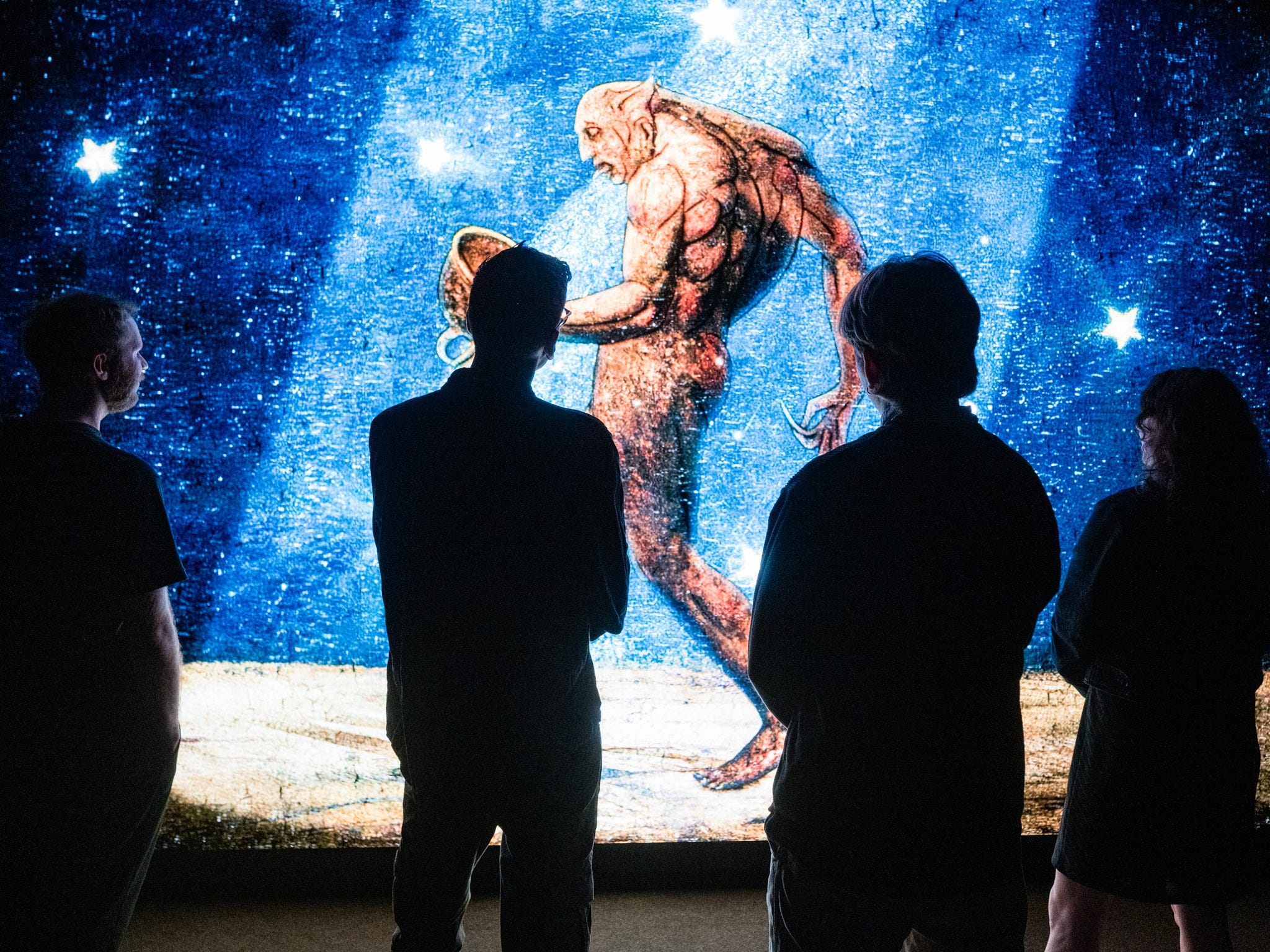
It was in part because the venue — a palace — was so unusual, and in part because I didn’t really understand why they’d chosen to enlarge Ghost of a Flea. This is a small tempera painting which Blake painted for his friend, Thomas Varley. It’s a highly intimate picture — a little portrait of what Blake envisioned the soul of a flea would look like. So why did they choose this painting? I had to find out.
The Venaria Reale is slightly outside of Turin, so it stands alone in an almost desolate landscape. On a weekday morning, the whole place is totally empty, so I was the only person there. It’s so big that it has about ten different entrances and, once you’re inside, it’s almost impossible to not get hopelessly lost. This is no bad thing: the rooms are full of wonderful installations, including portraits of the previous owners, architectural models, cinematic projections, and organic sculptures. The whole experience is a little strange, but highly adventurous.
Having finally located Blake on the second floor, I wandered into the exhibit entrance.
It was darkly lit, emblazoned with huge cutouts of Henry’s Fuseli’s (yes Fuseli’s, not Blake’s) figures from Paradise Lost. Feeling a bit like Alice at precipice of the rabbit hole, I shuffled forth.


The Exhibition
Blake and His Era: Journeys Through the Time of Dreams (curated by Alice Insley)
This exhibition does what I thought it was impossible to do. It simultaneously places Blake in his social, historical, and artistic context, while also retaining the spirit of enigma and awe which more academic exhibitions sometimes lose out on. It’s really quite unlike any exhibition I’ve seen before.
I don’t think we can discount quite how important the palatial setting is to achieving this effect. The Venaria Reale has corridors, hidden rooms, alcoves, and above all a sense of stately gravitas, that most museums simply can’t match. There are infinite curatorial possibilities in a space like this one — and they’ve taken advantage of it in many creative ways.
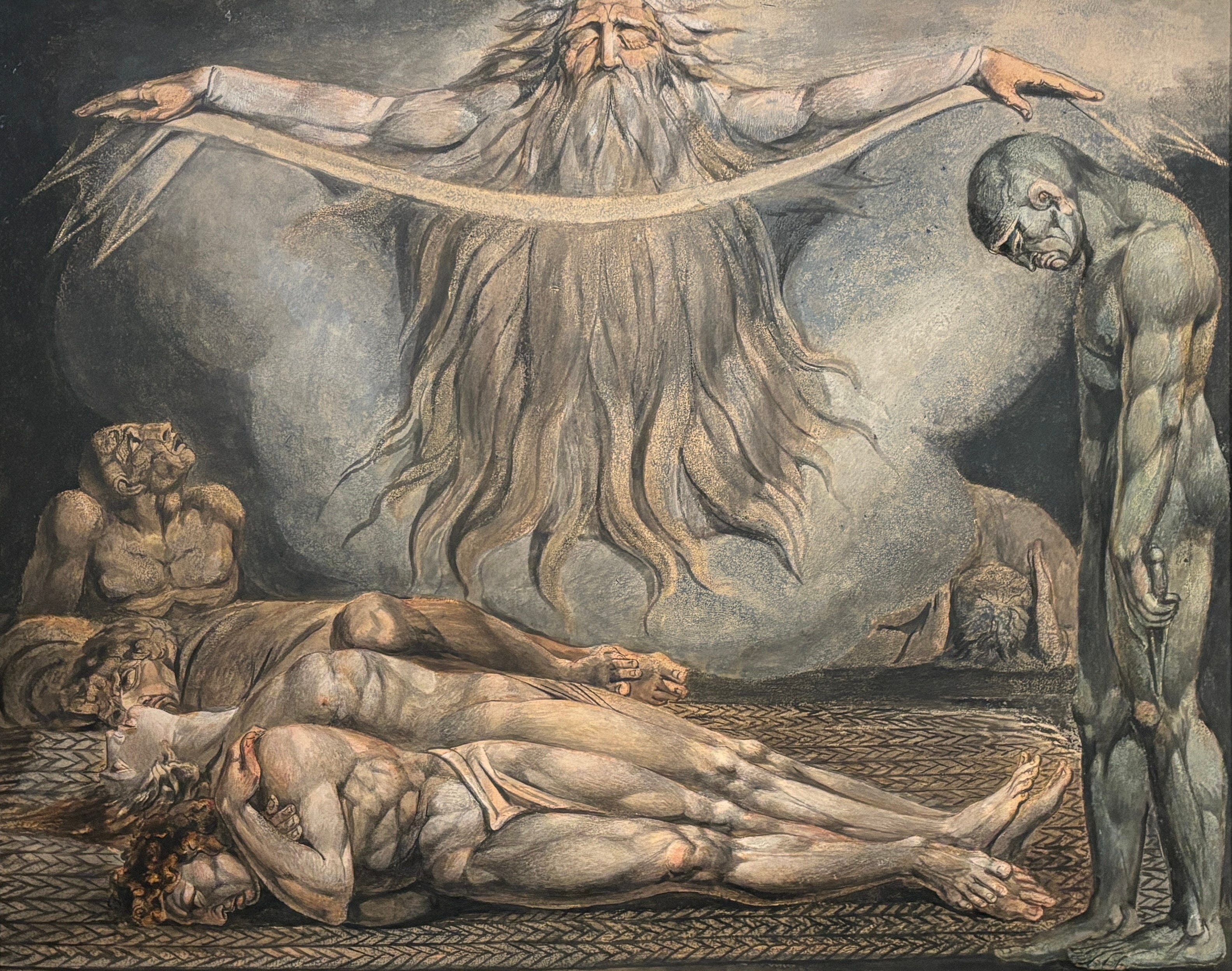
The opening section is very strong. Immediately we’re met with two of Blake’s most powerful images (The House of Death and Hecate). Directly following are works by other contemporary artists: John Hamilton Mortimer, de Loutherbourg, James Barry, and George Richmond. To see Blake placed within a wider circle of artists pleased the academic in me, but it also satisfied my inner Romantic to see that his pictures were by far the best among them. A quotation on the wall, from a young follower of Blake’s, Samuel Palmer, expresses the point beautifully: ‘He was energy itself, and shed around him a kindling influence; and atmosphere of life’.
A transition in the middle of this section is a giant, glowing projection of Blake’s The Spiritual Form of Pitt Guiding Behemoth. This is an image of the British Prime minister (1783-1801, 1804-06) in the midst of a warlike apocalypse, surrounded by Biblical beasts. Around 1809, Blake wrote that he wanted to paint pictures like this one as large-scale murals in London’s churches and civic buildings.
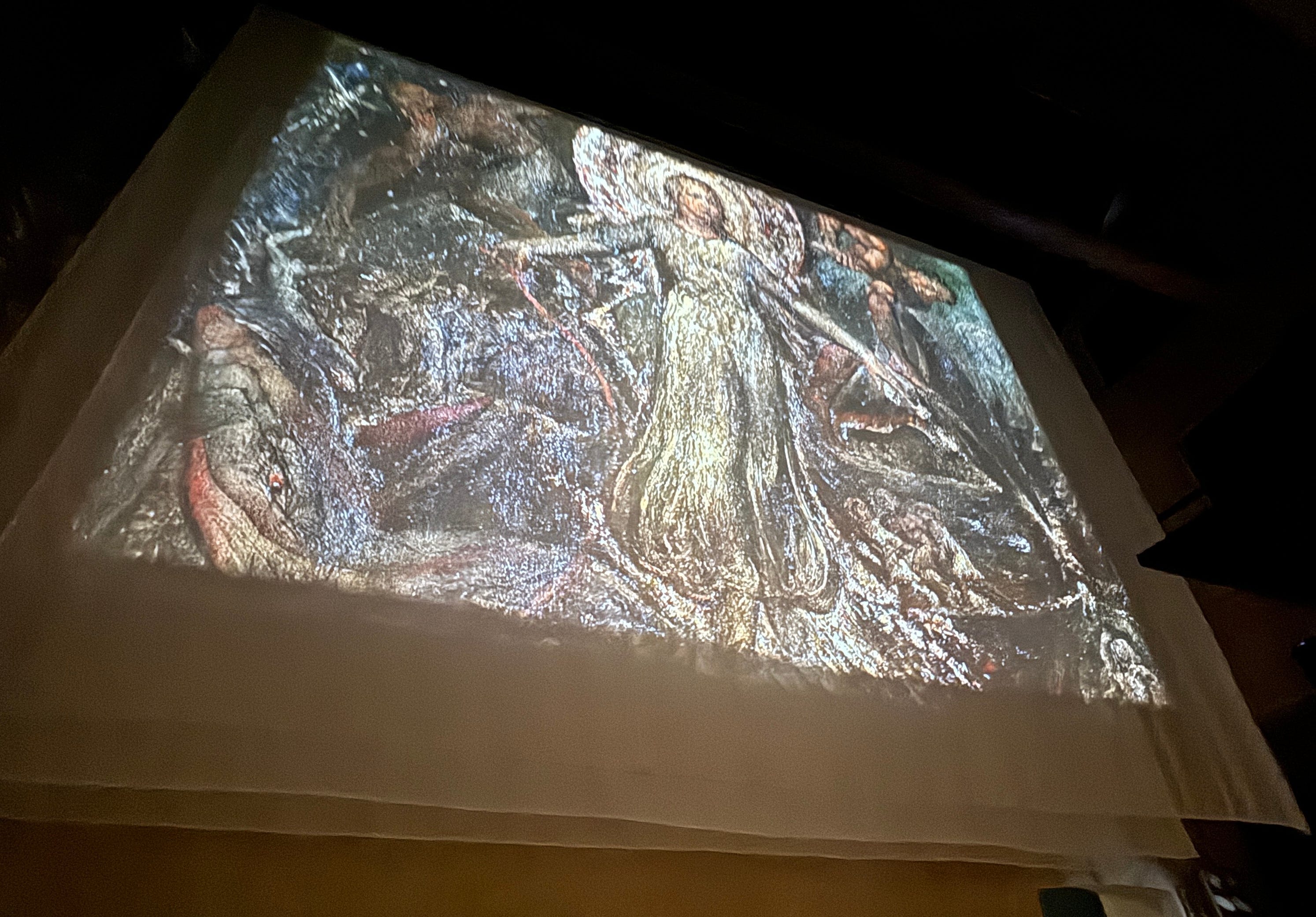
Thereafter, we’re shown two masterpieces. Blake’s Stoning of Achan and The Body of Abel found by Adam and Eve. Both are intensely violent. They convey narratives of religious transgression and death. The figure of Achan is an emblem of heroic suffering in the face of persecution. The face of Cain in The Body of Abel is a haunting expression of remorse, beset by a terrible red sun. This latter painting bursts out of its bright gold frame. Both eclipse the contemporary horror scenes on the opposing walls.


Next came a room on Blake’s ‘Fantastical Creatures’. The key work here is Blake’s aforementioned Ghost of a Flea which, in person, is a tiny, dark, inscrutable picture. I’ve seen it before, but never noticed Blake’s signature. It’s a whisper of white, hidden behind a curtain, on an otherwise inky background.


Thereafter, we move into the realm of ‘Enchantments’. In this section we get to see works by some other big-name Romantics: John Hamilton Mortimer again, Henry Fuseli, and Sir Joshua Reynolds. Unfortunately we also have some Theodor von Holst (I will not elaborate).
These paintings all show the ways in which artists contemporary to Blake were also engaging in fantastical subject matter and English folklore. We see fairies, sprites, and characters from Shakespeare’s Midsummer Night’s Dream. These serve to accompany the Shakespeare painting by Blake which is on the exhibition’s promotional poster: Oberon, Titania, and Puck. It’s one of his large colour prints from 1795. It’s playful, light, and unusually tender… until you look at Puck’s expression, which is full of sinister mischief.


The best of this room, however, are Blake’s small printed plates from the illuminated books. No attempt is made here to explain these (which I love, because even in context Blake’s plates are mostly inscrutable). Instead, they’re simply displayed as a family of emblems, and we’re encouraged to draw links between them. Levitating and crouching figures, infants, flowers, spirits, and deep, dark blues… it’s clear why these pictures are in the ‘enchantments’ section.
The following two rooms are focused on ‘Romanticisations of the past’ and ‘the Gothic’. Blake’s presence is lesser. These are important historical analogues by which to understand Blake, but they aren’t populated by any particularly powerful works of his. There is one dark, experimental tempera from his exhibition days (1809-10), The Bard, as well as some of the Biblical watercolours: The Entombment, Judas Betrays, and Bathsheba at the Bath. We do, however, get a Sir Benjamin West, and even J. M. W Turner! So, still in great company.
Transitioning, then, to the penultimate room we’re taken down a pitch-black, arched corridor. At the end of this is an upscaled, backlit version of The Inscription over the Gate, from Blake’s illustrations to Dante’s Inferno. It’s a picture of Dante and Virgil at the gates of Hell.


And which room are we about to enter? The Hell room, of course. It’s bright red, and we’re smacked in the face with Satan Exulting over Eve, Satan Smiting Job with Sore Boils, Urizen, and a host of Blake’s pictures from the Inferno. It’s moody, heavy, and thematically committed.
Satan in his Original Glory is the standout here. In this image, we see all of the ambiguities, the contraries, which define Blake’s work. This is Milton’s Satan in his full angelic power. He’s not yet Fallen, but there’s something sinister in his blank gaze. His shining white wings contain an echo of that fiery orange which we know will come to define his future.


The final room is a triumph. I know this because I usually hate it when exhibitions finish with cinematic features, and I was enraptured by this one. It consists of a series of twelve animations of characters from Blake’s works, accompanied by a deep, meditative soundscape.
Suddenly, despite all my scepticism and snobbery, the childlike wonder that I thought my education had forever suppressed in me came flooding back. Face-to-face with Blake’s Ghost of a Flea, Nebuchadnezzar, Oberon’s fairies, and the Good and Evil angels — life-size, luminous, and human — I was reminded just why it is that I was drawn to Blake in the first place, ten years ago.
It’s because his works, in their bright colours, bold lines, and wild anatomy, appeal to the imagination, while also being anchored in the violence, intensity, and darkness of reality. It’s this ambivalence between childlike wonder and adult knowledge which give Blake’s works that power. When you see Newton using his compasses, or Satan flapping his wings, right in front of you… it really does feel like a visionary experience.
I was alone in that room, and I watched the full cycle of animations before leaving. I’m still thinking about it now, and imagining whether there might be scope for a feature-length Blake movie which would be entirely animated. It wouldn’t be biographical, instead it would be an epic, Miltonic journey from Eden to Hell and back again.
Would you watch it?
This exhibition is on until the 2nd of February 2025.
Fin.
Blake's reputation can get in the way of appreciating his work sometimes - the deluge of everything written about him. This includes his 'mystic' reputation too, imo. I connected with Blake again post-PhD when I saw the brush strokes in his work up close. It was the humanness, not the mystic, that drew me back in 💜 beautiful article/ review, tysm 🙏
Thank you! You just reawakened in me a fascination with Blake that's been dormant since my teens. Also a renewed interest in the possibility of using animation to give new dimensions to some of my other fascinations..
Great writing. Thank you 🙏🏻